Showing posts with label Stadium Advocacy Articles. Show all posts

Monday, October 17, 2016

The 2016 Favorable Changes to the DC United Stadium Design

The public spat in front of the Zoning Commission in 2016 between D.C. United and stadium area developers led by Akridge has resulted in a much better design for the stadium at Buzzard Point. We are on record about being bothered that the stadium wasn't blending as well as it should with its surroundings. We thought some brick accents on various parts of the exterior would help overcome a look that seemed too industrial for a neighborhood about to blossom with new residential and retail development.

The latest designs under review at the Zoning Commission last week do indeed have more color than previous renderings. That's moving in the right direction. But the Commission still wants a building with less basic off-white color, less advertising, less of the underside showing, and easier public access. Let's look at some of the recent changes.

Wednesday, May 4, 2016

A 2016 View of How the New DC United Stadium Fits in at Buzzard Point

The front of a soccer stadium

By Douglas Barnes, David Rusk and Tod Lindberg

Inspired by our walk around Buzzard Point and the recent demolition event, David, Tod and I took a second look at the DC United stadium design. There have been plenty of complaints about the neo-industrial style of the stadium plans. Perhaps the design is an attempt to mimic the industrial character of the Buzzard Point area, one of the city's last industrial pockets. Maybe a better approach would be to put the past aside. After all, an old scrapyard is not exactly an inspiring theme for a new stadium.

DC United may have already changed some aspects of the renderings. In an interview with the Washington Post at the demolition event, Jason Levien indicated that he and DC United are focusing on the design and the implementation of the stadium. He said, "We like what we're seeing. We think it's going to be a terrific venue."

This follows the more critical comments made by Marcie Cohen of the DC Zoning Commission, who was quoted recently in the Washington Business Journal as follows. "I actually looked at it and I thought, this reminds me of a prison, the facade. I think we need to get a little bit more, maybe a little bit more friendly to the neighborhood, because if I'm looking at the facade, I wouldn't be too happy with that view." So the question is how will the new stadium fit in at Buzzard Point?

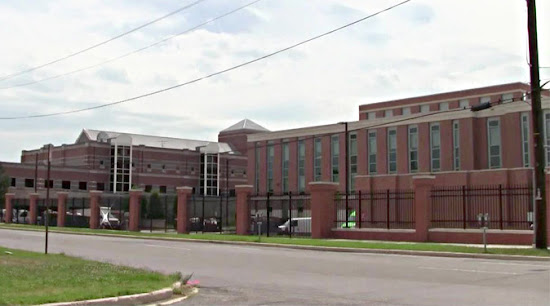
In our meandering walk around Buzzard Point, one area that stood out was the pleasant brick and steel fence along Second Street, SW. Although this is the perimeter of National Defense University, the fence reminds us that most of the residential areas in Washington DC are populated by brick houses. Many of these are colonials.

Of course, architects generally hate this boxy style, as being too formulaic and harkening back to the past. It's true that in DC in the 20th-century colonial-style houses were stamped out in a typical configuration of a center hall or side hall design. But walking through DC neighborhoods is a pleasant experience, and brick is a visual common denominator.

Brick University buildings
Defense University in Washington, DC
(Image: Doug Barnes, 2016)

Further up from the National Defense University is Fort McNair and the neighborhood area of Buzzard Point. Not surprisingly brick is also a theme in this neighborhood.

In 2014 David and Doug on their advocacy walk were quite impressed with the walk along P Street, with the graceful trees, red brick walls, brick apartments, and brick houses. Some art nouveau 1960s townhouses, their exterior pale colors now fading, break the pattern on occasion, but with the common brick exteriors, the general feel of the area is pleasant.

The red brick wall of Fort McNair is mirrored on the other side of the street in both low-rise apartment buildings and houses. This, of course, is a pattern replicated over much of Washington, DC.

Brick wall and street in Washington, DC
Brick Wall at Fort McNair, Washington, DC, 2015
(Image: Doug Barnes, 2015)

The monuments in Washington, DC are constructed mostly from marble and granite, featuring various shades of grey and white. Also, the downtown buildings are more neutral in color. The color scheme of the exterior of the new DC United Stadium may be a decision for later, but the January 2016 renderings of the stadium feature the same neutral color scheme. The early stadium design sticks to the grey and white color scheme of the monuments and the downtown buildings.

The nearest neighbor to the DC United stadium is National Defense University. Other buildings will be constructed only after the stadium is complete. The picture below is taken from the intersection of 2nd and T street looking south from the stadium's southwest corner. The combination of the prevalence of brick in Washington DC's neighborhoods and the nearest Buzzard Point building complex means that the use of this material should at least be given consideration as a connecting theme in the new stadium.

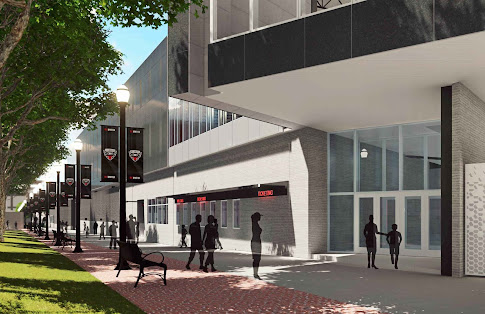
The current renderings of the DC United stadium actually have plenty of brick in them, but they are on the ground as pavers on the stadium walkways (see beginning image). Most veneers are gray, adding to the industrial look of the planned stadium.

The walkway is constructed from red brick pavers, but overall the look is very institutional. This rendering is of the grand walkway that runs down the east side on the outside of the stadium, over or near PEPCO's right of way. This is one of the first views fans will have coming from parking and the subway near Nationals Park.

Another possibility would be to construct the stadium accent veneers out of the red brick so common in Washington neighborhoods. This was actually done for Camden Yards, not because of connections with the neighborhoods, but with the brick warehouse that provides the backdrop for the view of right field. 

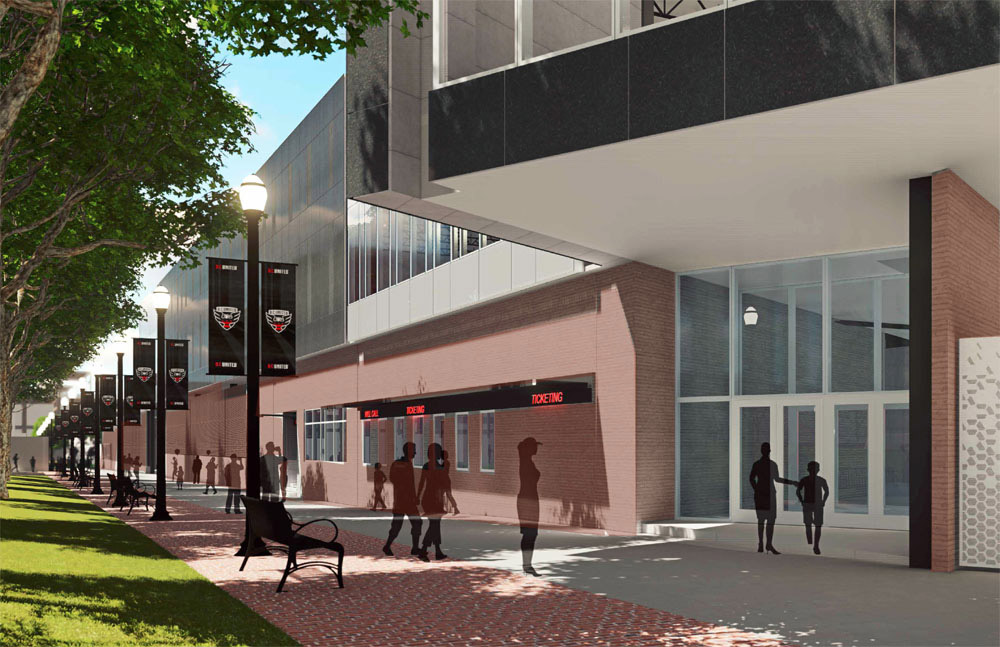
Perhaps, in the same way, the veneers of some of the ground-level structures of the new DC United stadium could be made of red brick, taking a cue from the pleasant neighborhoods of DC in providing a base for the stadium rising above. To see what it might look like to have red brick at the base of one part of the stadium, we've modified the official January rendering in Photoshop (see picture below).

The entrance to a soccer stadium drawing
DC United Stadium Entrance Illustration with Brick Facade
(Modified Image: Doug Barnes, 2014)

It would be nice to have a building that is consistent with the feel of DC's neighborhoods. Perhaps it doesn't even have to be brick, but the color of brick. The present drawings list the base material as "form liner cast in place concrete with wood plank texture." This could easily be changed to be of brick texture and color with little difference in cost, with some key areas of the stadium faced with real brick.

You've already guessed which of these versions we like better. According to our view, the brick feel is warmer and less institutional.

A 2022 Update

The DC United stadium at Buzzard Point officially opened in July 2018. The facade of the building was not brick. Instead, the team stuck with the plain exterior in the original drawings.

The stadium does fit in very well with the neighborhood. As of 2022 many new buildings are being constructed around the stadium at Buzzard Point and they are mostly mixed residential and retail. This will create a buzz around the stadium as the area transitions from a fairly remote part of DC to a new region for sports-related and other events.

Soccer Stadium Entrance with People Entering
Actual DC United Stadium Entrance at Buzzard Point, 2019
(Image: Doug Barnes, 2019)

The stadium is a large presence in the neighborhood and has spurred development beyond expectations at the beginning of the project when the newly elected Mayor Bowser called the area "very isolated."

A brick-clad exterior may have softened the presence of the stadium in the neighborhood but the building turned out to be attractive and well designed. It does not have the cookie-cutter appearance of most new stadiums in the league which makes for interesting viewing angles in both the interior and exterior. Also, due to its compact design, there is not a bad seat in the house.

*****

Note:  All images by Doug Barnes.

Tuesday, April 7, 2015

A Look at DC United Attendance in RFK Stadium, 1996-2014

RFK Stadium, Home of DC United 1996-2017
(Image: Doug Barnes, 2019)

By Doug Barnes, David Rusk, and Tod Lindberg

The attendance at the DC United home opener in 2015 was disappointing. Newcomers Orlando had 62,000 and New York City FC 43,000; phenomenal Seattle had 40,000. The 2015 D.C. United game in Orlando had over 30,000 fans in an old football stadium. 

This got us questioning what has gone wrong with the team that a mere 11,500 souls would turn out for the first home game of the 2105 season and less than 15,000 for the second game. We keep hearing that DC United fans are the best supporters in the country. This is true for the core of supporters who are passionate about the team and very sophisticated soccer fans. A smaller minority of these boisterous fans loyally travel to away games.

The low attendance in both the first and second home games raises some questions about the less committed fans. How did a team that was first in the Eastern Conference last year come in dead last in attendance the opening weekend?

D.C. United and MLS

Until recently DC United stacked up quite well compared to the rest of the league. United consistently had over 17,000 fans attend games from 1996 through 2010 (table 1.1). This was above the MLS average. Thus, historically United's attendance has been quite good. However, fan attendance since 2011 has dropped to less than 15,000. The reason for this pattern can probably be traced to the history of the club.

The team was a consistent winner in its early years with identifiable heroes. The likes of Marco Etcheverry, Jaime Moreno, John Harkes, Jeff Agoos, and Eddie Pope, all national team regulars, accounted for the backbone of a team that consistently played soccer at a high level. They lost their share of games, but even when they were losing the team had strong players that fans could appreciate. In 2004 a side with the likes of Earnie Stewart, Ryan Nelsen, Christian Gomez, and Ben Olsen won its most recent MLS Cup. In 2006 and 2007 they won the Supporters Shield but flopped in the playoffs.

After those glory years, the team faltered. The reason was that some high-profile foreign player additions flopped, ownership changes unsettled the team, and two failed attempts at securing a new soccer stadium left the soccer fans wondering if their club would remain in DC. Since 2008 the team has been hard-working, but never really seemed to be able to recapture the magic of past years or be able to recover from the off-field problems. The result was that two years later in around 2010, many more casual fans began to stay home. In the period from 2011 to 2014, team attendance declined just at a time when attendance for other MLS teams was increasing. At this time DC United's marketing team was fighting a losing battle, and also made some mistakes in failing to appreciate the team’s core fans.

Table 1. DC United and MLS Single Game Attendance Averages, 1996-2014
(Source and Image: Doug Barnes, 2015)
One strong message emanating even from DC United management during those years was that RFK was a dump. Certainly, RFK was a poor economic venue for DC United. Also, with the construction closing of the Southeast Freeway from the 14th Street Bridge eastward, the stadium was hard to reach by car for Virginia fans. The food was not good (with the notable exception of the pupusa stand). The restrooms were not up to par. The concrete was cracking. Many seats were clapped out. The saving grace of RFK was that for fans it is a good stadium for viewing soccer games.

The team should have started building up its popularity even before the new stadium was built. In 2015, the battle for a new stadium had been won, and the negative conditions of RFK should not even have been publicized during the new construction. It would have been a good idea to praise RFK's legacy and highlight all the good soccer that United had played in this historic venue. The emphasis should have been placed on how the traditions from RFK carry over to the new stadium.

The ambivalence of watching soccer at RFK was nicely summed up by Steve Goff during its last days as host of DC United complemented by his recollection of frequently attending US Men's National Team games:

"RFK could be down to its last cracked and crumbling chunk of asbestos, and I would still prefer attending a game there."

He was conveying such a positive message because despite the issues with the stadium, actually watching soccer being played at RFK was a great experience. The grounds crew did an excellent job. Lot 8 was ideal for tailgating and communing with other fans. But the not-so-subtle message from DC United management was the stadium was unfit for its fans.

The negative view of RFK as an economic venue by team management no doubt had a chilling effect on attendance. The constant search for a new home projected a negative view to fans that the RFK was not a proper place for soccer and also resulted in a feeling that the team might move out of Washington DC. Another issue was that due to poor economic conditions, the team did not have the financial resources to keep up with the rest of the league by investing in good players.

With one hand tied behind its back, United was expected to stay within a small budget and win trophies. Perhaps the team should have started applying a "Moneyball" approach to soccer earlier, but the reality was a team that relied more on grit than talent. Certainly, there was some talent on the recent teams, but they lacked the flair of such players as Christian Gomez, Marco Etcheverry, and Jaime Moreno.

The New Stadium: Will it Bring Higher Attendance?

The DC United stadium at Buzzard Point cost a total of $500 million to build that included both private and public investments. The city of Washington, DC purchased the land for the stadium and provided supporting infrastructure such as roads, sidewalks, and water commonly referred to as horizontal costs.  DC United footed the bill for all verticle costs that included the construction of the stadium itself and everything within its footprint.

This put DC United in a position to leave the negative rhetoric about RFK behind. But the question at the time remained. "Will the new stadium bring higher attendance?"

The evidence from the league was that the impact of the stadium might be modest (table 2). With the exception of Kansas City, most of the new stadiums in MLS as of 2014 have resulted in gains of 2,000 fans or less. Three teams - Chicago, Colorado, and Columbus - all had seen increases in fan attendance of less than 1,000 per game. Thus, new stadiums may bring about financial gains for the clubs and short-term spikes in attendance, but over the long term, they are not a panacea for assuring new fans will come.

Table 2. Game Attendance in MLS Before and After New Stadium, 1996-2014
(Source and Image: Doug Barnes, 2019)

As an aside, Seattle is an outlier in MLS, playing soccer in a relatively new football stadium that is downtown. Is the success of Seattle due to a local soccer culture, the downtown location of the stadium, or the consistently good teams? Until 2014, Seattle had extensive marketing support from the Seattle Seahawks.

In addition, the Sounders had established a Fan Alliance with representatives who serve on an advisory board for the organization. The representatives of the Fan Alliance had monthly meetings with team management including those on the soccer side to discuss selected issues. All MLS executives no doubt would like to know the magic touch of Seattle in drawing fans, but as of 2014 none were able to replicate the feat.

The conclusion is that the new stadium at Buzzard Point will boost attendance, but the team also needs to take care of other factors as well. This includes the attractiveness of the team's play, their record, marketing, and other factors. We will take a look at some of those issues in the next section.

Non-Stadium Factors That Impact Team Attendance

Until 2008, D.C. United had relatively good attendance numbers. One of the reasons for the fan support had been that the team in its early years was a consistent winner. There were a few down years, but those were followed by good years. In a league where parity was the word, DC United's management was able to out-think the opposing clubs. Capturing on average 55% of all possible points, Bruce Arena had the best winning percentage of all United coaches before taking over the USMNT late in 1998.

In his first year as coach, in 1999 Thomas Rongen managed DC United to a third MLS Cup, perhaps. He retained both the same players and tactics successful under Bruce Arena. Without management worried about a new stadium and threatening to move the team to Baltimore or beyond, United was able to maintain attendance figures of about 17,000 (above average for the league at the time).

After some down years under Ray Hudson - who arguably is a better announcer than a coach - took over in 2004 and won MLS Cup straight away with the help of such players as Christian Gomez, Earnie Stewart, Jaime Moreno, and a healthy Alecko Eskandarian (14 goals).

The wheels started to fall off the bandwagon during Tom Soehn's tenure, which began in 2007. The seeds of declining attendance were sown in 2008 (table 3). This was a time when the first stadium initiative failed. Also, after the signing of the Argentinian star Marcelo Gallardo ended poorly, DC United reduced investments in new players.

This decision to not invest in new players was partly due to the advent of the severe recession and the uncertainty of being able to have a new stadium and long-term home in the DC metropolitan area. In addition, this also was a time when Designated Players started to allow other teams to make investments in higher-priced talent.

Fans in the Washington, DC area had to constantly listen to threats from DC United management that they would move the team to another city if the District's government failed to support a new stadium. All the talk about loyalty to the badge somehow took on a hollow ring when fans saw a lack of investment and were unsure whether the team would stay or go. Attendance plummeted from a high of 21,000 in 2007 to just below 14,000 in 2012. The core fans were still loyal, but clearly, the bloom was off the DC United rose.

Table 3. DC United Stadium attendance and Performance by Coach, 1996-2014
(Source and Table: Doug Barnes, 2019)

A Possible New Era Starting in 2014

United was starting a new era in 2014. New owners joined Will Chang in 2012, and those new partners brought financial resources to the team. The new owners that were led by Jason Levien promised to finance the stadium construction costs. After a stadium campaign that included support from and groups, DC United was able to win approval by the DC Council to pay for land acquisition and site improvements. The new stadium was located in a fantastic new location called Buzzard Point which is right next to Nationals Park and only 1.1 miles from the US Capitol.

The new stadium offered the team the possibility of a better financial model with prospects of making new investments in marketing, players, and coaching. This was only partially successful because DC United management had to pay for the stadium.  As a result, they continued to pinch pennies until the opening of the new stadium in 2018.

In 2014, the evidence from other teams suggested that the new DC United stadium will not be a magic force for increasing attendance. Over the medium term, it will probably only mean 2,000-3,000 new fans per game. After reorganizing the team in 2011, the young coach Ben Olsen performed erratically. In 2011 and 2013, the team won only 38% and 16% of possible points. In 2012 and 2014, United won a respectable 57% and 58% of possible points. These ups and downs combined with the lack of identifiable stars hampered the team in building an extended fan base.

One should keep in mind that for DC United, team success does not turn into attendance growth right away (figure 1). Generally, there has been a 2 year lag between DC United team performance and improved attendance. This means that more wins at the start of stadium construction in 2015 would not lead to higher attendance until 2017.

Figure 1. Team Performance and Game Attendance, 1996-2014
(Figure and Image: Doug Barnes, 2019)

For winning seasons, there may be late-season surges in attendance, but for DC United, those figures are offset by the empty seats earlier in the year. To make believers of fans, teams need more sustained success and a core group of talented players. This helps the fans identify with the team and players. This is borne out by an analysis of team performance and attendance.

For DC United, there was virtually no impact of team performance on fan attendance in the same or even in a year following a successful season (table 4). It takes two years for performance to translate into fans filling seats. For every 10% increase in performance in a given year (total points won of possible points), fan attendance increased by over 1,000 fans two years later.

The pattern may be different for teams in the rest of the league, but the evidence suggests that as of 2014 for DC United success translates into attendance gains only after 2 or 3 years.

Table 4. Impact of Team Performance on Attendance, 1996-2014
(Source and Image: Doug Barnes, 2019)

So what are we to make of these attendance findings? One was that improvements in team performance in 2015 would have been extremely important promoting good attendance when the new stadium opened in 2017. Unfortunately, the team position was that it wanted to wait for the economics to improve before making a significant investment in players. This is all well and good given their financial burden, but it ignores the 2-year lag that improving team performance has on team attendance. Two to four thousand fans may not seem like much, but throughout an entire season, the returns could be significant both in fan interest and revenue. 

Recommendations Updated for 2022

Here are some revised recommendations first offered in 2015 that might still have lessons for 2021 on how United might boost attendance and its popularity in Washington, DC, Maryland, and Northern Virginia regions:

The team still needs to ramp up spending on quality players so that DC United would be an exciting team to watch. Even though the stadium has been open since 2018, this year's attendance has lagged expectations. Some of this lag may be due to the Covid pandemic. The team has an exciting new coach and has made significant investments in facilities. Unfortunately, the investment in players has trailed many teams in the league. DC United does not have the allowed 3 designated players.

United should do a better job in marketing the team to the more general public while keeping its dedicated fans. In the lead-up to the new stadium, DC United started to televise every game. After the new stadium inauguration, the team faltered significantly by contracting FloSports to stream every game and charge all fans for viewing the stream. This included season ticket members who were already paying DC United significant sums to engage with the team. This disastrous policy was followed this year with almost all games being televised by a local sports network and also streamed on DC United's website. These are both good policies for keeping existing fans interested and recruiting more casual fans.  This policy should be continued in the future.

The new DC United stadium at Buzzard Point is now a reality but the past should not be forgotten.  In the first years in the new stadium, the team pivoted to the future and seemingly forgot its past. This was corrected in the last couple of years and this emphasis on the team's traditions should be continued. The remembrance of teams playing in RFK Stadium should not be forgotten as DC United embarks on a  bright future.

With all the new construction, Buzzard Point is quickly transforming from abandoned lots and scrap yards into one of the best and most unique neighborhoods in Washington, DC. With both DC United and the Nationals as feature attractions, DC United has a unique opportunity to market and integrate the team within its new unique environment.

Buzzard Point--which previously was a blank slate--will quickly become a community with old low-rise neighborhoods, public affordable housing, and new multiuse buildings. DC United needs to work with the community to make the surroundings of the stadium a unique place to visit. DC United should embrace both the name Buzzard Point and the community.

The efforts of DC United should not be limited to the stadium alone. The team is part of a greater neighborhood. The team can take advantage of a unique opportunity to weigh in on the development of local parks, the Anacostia Bike trail, and South Capitol Street Development in ways the enhance the value of the stadium. These all can help with pregame festivities and safe pedestrian travel to and from games.  A symbiotic relationship between DC United and the community would lead to enhancements in which the sum is greater than the individual parts.

Parking around the DC United stadium is an issue that will probably get worse. As the lot south of the stadium is developed, parking in that lot will disappear.  Recently DC United has been relying on SpotHero for its fan parking with a nominal discount to DC United fans. This makeshift arrangement is probably low-cost for DC United administrative responsibilities, but it does put another barrier in front of fans wanting to attend games. More effort needs to be made to secure parking at discounted prices for those who want to drive to the DC United games.

More actions need to be focused on promoting season tickets and tickets to casual fans. Now that DC United is settled into its new stadium and with the pandemic subsiding, other initiatives also need to be used to garner more general support for the team. The team's marketing outreach and approach should be firing on all cylinders.

One sore point among some fans that needs to be corrected is that the roof of the stadium has never been fully completed. It is admirable that solar panels now generate much of the electricity for the stadium, but DC United has never completed the roof over its expensive midfield seats. Season ticket holders in these sections pay thousands of dollars per year for their seats. DC United has never explained to its fans why it would build a $500 million dollar stadium and not finish the roof. This needs to be corrected in the near future.

A gathering spot similar to lot 8 at RFK stadium would be a great draw for DC United fans to come early to games.  Right now fans trickle into the stadium delayed by metro and other issues.  One suggestion is that on game day, perhaps Potomac Avenue could be blocked off and lined with pregame-sanctioned food tents and other welcoming events.  Perhaps the new building that will be constructed next to the stadium could have some kind of welcome fan zone.  Having a gathering place for fans would greatly enhance not only attendance at DC United games but also the timeliness of fans entering the gates on game day.

Last but not least, the name Buzzard Point is now becoming a very trendy name and even has a website of its own financed by local developers. In other words, the name Buzzard Point has been embraced by the real estate community.  DC United should join in with them and recognized that the team is located at Buzzard Point, perhaps even calling the stadium Audi Field at Buzzard Point.

The glory years are past and have left a proud legacy for the team. The football maestros of RFK are all now retired. The years of uncertainty during the long stadium quest took a great toll on attendance. As of 2018, those times were over, but they had left their footprint on the team.

Today, DC United still has a chance to establish itself firmly in its new era. The core fans are in place and they are the best in MLS. This core needs to be expanded and complemented by rising season ticket sales, a better quality of play, more appealing marketing, local fan zones before games, and better parking options. This will lead to an attraction of more casual fans and future DC United season ticket holders.

Friday, December 19, 2014

Giving Thanks for the Approval of New Buzzard Point DC United Stadium, 2014

Post Stadium Approval Celebration
by Dave Kasper, Jason Levien, Ben Olsen and Tom Hunt, 2014
(Image: Doug Barnes, 2019)

by Tod Lindberg, Doug Barnes and David Rusk

The D.C. United stadium at Buzzard point is now approved by the District Council (as of December 2014). To achieve this miracle required a perfect storm of support from United, the current mayor, the mayor-elect, the DC City Council, Buzzard Point landowners, the business community, supporters groups, local soccer organizations, and casual fans. A thanks to all.

Many people deserve the gratitude of each and every D.C. United fan for their contribution to the successful conclusion of the stadium deal. We've started a list, and are checking it twice. We're sure we'll miss some people: For example, DC Council staffers in the Wilson Building who have toiled for this project anonymously. We apologize in advance, and we'd encourage all in the B&RU community to add names they know in the comments.

It is the time of year to give thanks, and this is especially the case for DC United fans. So in more or less chronological order, based on the progress of the stadium:

Thanks to the DCU ownership group, Erick Thohir, Will Chang, and especially point man Jason Levien, for their commitment to stay in DC and for approaching the negotiations with patience and a realistic sense of what the city would be willing to shoulder for the new stadium.

Thanks to Mayor Vincent Gray for putting the stadium high on his agenda. He started the ball rolling, and now it is being kicked all the way into a new stadium. He leaves office with a considerable legacy at Buzzard Point.

Thanks to City Administrator Allen Y. Lew, the District's point man on the stadium negotiations, for putting together a realistic plan that would benefit the city as a whole. He also did all the negotiations over the land and commissioned supporting studies on urban planning, traffic, costs and benefits, land values, and environmental studies.

Thanks to City Council Chair Phil Mendelson for retaining an open mind throughout the process, for his decision to commission an outside expert firm to assess the stadium deal, and for paying heed to concerns expressed here and elsewhere that the cost-benefit analysis needed to assess the project over its full 30-year life, not just 10 years. He seemed like a stadium Grinch early on but became one of the stadium's biggest supporters at the end.

Thanks to those responsible for preparing the reports rightly demonstrating that the proposed stadium deal was good for the city as a whole. First up was a Brailsford & Dunlavey study for the city administration. Next came the joint effort of Convention, Sports & Leisure International (CSL), the Robert Bobb Group and Integra Realty Resources for the Council. They all did a thorough and credible job. The CSL cost-benefit report in particular gave the DC Council comfort that the DC United stadium was a good investment for the District. Along with the urban, transportation, environmental and real estate studies, these reports cleared away the many political concerns regarding the stadium.

Thanks to Mayor-elect Muriel Bowser for taking ownership of the stadium project in the Council after her election. She consistently stated that she wanted to keep DC United in the District, but we often did not believe her. She quickly recognized the political difficulty of including the Reeves Center as part of the Stadium Act and worked to find an alternative solution while keeping to the critical end-of-year timeline. With her leadership, the Council crafted and unanimously approved legislation. It was an impressive debut for the incoming mayor. Now we believe.

Thanks to the entire DC Council for approving the stadium legislation unanimously, demonstrating citywide support for the project. A special thanks goes to Council Members David Grosso and Anita Bonds for meeting with District Citizens United for a Soccer Stadium (DCUS) and sharing their insights on possible ways forward. They both were very gracious.

Thanks to the late Marion Barry for his support as well. Looking around at the councilmembers he kept saying at the public meetings, "I've supported a stadium for DC United long before anyone else here." It was true.

Thanks to Ben Olsen and all the DCU players and coaching staff for presenting a conference championship season as the backdrop for work on the stadium negotiations. Everyone was hoping for a turnaround after winning only three league games last year. But worst-to-first was an unexpected gift.

Thanks to DCU Chief Operating Officer Tom Hunt and his management team for constantly thanking us for our support, just as we were thanking them for keeping focused and staying positive in the face of the major obstacles to keeping DC United in Washington DC.

Thanks to all the parties to the stadium deal for negotiating in good faith with an eye toward reaching an agreement. A special note of thanks to Akridge for its consistent support for the new stadium. Even though they lost out when the Reeves Center was dropped from the final deal, they kept their expression of disappointment measured and pragmatic. You might say they "took one for the team."

Thanks to the business community and labor groups, which went out of their way to testify in support the new stadium.

Thanks to the Barra Brava, Screaming Eagles, La Norte, District Ultras and other supporter groups for being who they are and doing what they do. They are the "public face" of the fan base.

Thanks to all of the DC United supporters who contributed to the strong showing at the Council. A sea of Black and Red demonstrated support at all of the public meetings.

Thanks to Unite DC for effectively demonstrating the significant grass-roots support for the stadium to the Council.

Thanks to everybody who joined DCUS, the independent grass-roots organization the three of us set up to mobilize DC residents willing to express their views to the Council. All contributed valuable time and unbelievable effort to help make the stadium a reality. We especially thank the ward co-chairs.

Thanks to DC Stoddert and other District, Maryland, and Virginia soccer organizations willing to step up to express their support for a stadium in the District.

Thanks to Black and Red United for serving as the nerve center, a kind of mission control. Thanks to Adam Taylor, Ben Bromley, Jason Anderson, Martin Shatzer, and all the other correspondents, contributors, and posters here. The Black & Red United blog by far is the best in MLS.

Thanks to all the local journalists on the front lines covering the stadium story for the steady stream of accurate information. They were true professionals reporting a major local story through unexpected twists and turns, sometimes by the minute.

Finally, a note of thanks that it is rumored that Clyde Simms received a new kidney yesterday! The stadium is unbelievably fantastic news for DC fans, but if true, this is the greatest gift of all. We wish him a speedy recovery.

As for the three of us, let's just say we've never had more fun throwing ourselves into a challenging project. It brought together the unlikely threesome of a mayor, a researcher, and an editor, all with a passion for soccer. While we were delighted in the end to have an op-ed in support of the stadium in the Washington Post, the most gratifying aspect of the whole collaboration was getting to know and to work with those in the DC United community.

We promise to stay on the case and update you as stadium developments warrant until we are all sitting in the stands for the first match at Buzzard Point!

Friday, December 12, 2014

One Kick Away from a New D.C. United Soccer Stadium in Washington, DC

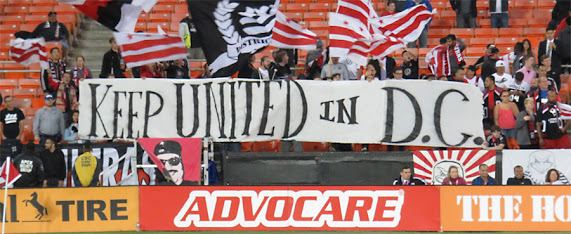
Soccer Fans waving banners
Fans at RFK Stadium Hold Banner to Keep United in DC
(Photo: Doug Barnes)

By Douglas Barnes, Tod Lindberg and David Rusk

First Published as Opinion in The Washington Post, December 12, 2014
Republished with minor updating, November 19, 2021

Preface: The writers are co-chairs of District Citizens United for a Soccer Stadium, an independent grass-roots group.

As committed soccer fans, we’re delighted that the D.C. Council is poised to give final approval at its next meeting to legislation that will enable D.C. United to build a permanent District home in Southwest. The Stadium Act won unanimous approval at the bill’s first reading Dec. 2.

And as District residents and taxpayers, we’re especially gratified that the stadium deal is good news for city residents, even those who are not soccer fans. The city will reap substantial benefits from the development of Buzzard Point.

The deal is a public-private partnership in which the city will acquire and prepare the site, then lease it for 30 years to the team, which will build the stadium. The District’s side of the partnership is capped at $150 million.

What kind of return will the city get on such a large investment? To start, D.C. United will stay in the District, and its owners will be making a $150 million investment to build the stadium. The team has been losing millions of dollars annually playing at the dilapidated RFK Stadium, and long-term financial success for Major League Soccer franchises usually hinges on the team owning and controlling the revenue from a stadium designed for soccer.

D.C. United’s quest for a stadium site has been one of the longest in MLS, spanning eight years and two false starts. If the Buzzard Point deal had fallen apart, the likelihood of the team remaining in the city, perhaps even the area, would have been low. Now the District will be the permanent home of a thriving business generating significant tax revenue.

How much revenue? The council commissioned the consulting firm Conventions, Sports and Leisure International (CSL) to conduct an independent assessment of the fiscal costs and benefits of the stadium deal proposed by Mayor Vincent C. Gray (D). The council has since altered the deal, dropping a controversial proposal for the District to acquire some of the land at Buzzard Point by swapping it for the Frank D. Reeves Municipal Center property at 14th and U streets NW. But the CSL study of cash in and cash out over the 30-year-plus life of the deal still supports the stadium site.

Let’s start with the basics. Say the District ends up laying out the maximum $150 million it has committed (D.C. United has agreed to pay any additional expenses). Over the 30 years of the deal, that investment will generate $187.2 million in new taxes in today’s dollars, for a net gain of $37.2 million.

In addition, the land the District is acquiring and will still own at the end of the lease will increase in value. Building the stadium, according to CSL, will accelerate local development and land appreciation at Buzzard Point by eight to 10 years. We have conservatively estimated that this faster appreciation of the land will add about $40 million in value in today’s dollars to the District’s Buzzard Point land.

All major infrastructure projects benefit from complementary investments. The nearly $1 billion the District plans to invest in the Frederick Douglass Bridge and the South Capitol Street Corridor would enhance the stadium by providing better transportation access and nearby green space. The stadium also would link development of the long-neglected Anacostia waterfront with the major new Wharf development along Washington Channel. All of these features will attract more soccer and baseball fans and people wanting to experience the new parks, restaurants, bicycle trails and other amenities coming to Buzzard Point.

The issues surrounding the Reeves Center property and the anticipated construction of its replacement in Ward 8 remain for another day. For now, though, the council looks poised to approve a stadium deal that is good for sports fans, residents and businesses in Southwest and all District taxpayers.

Thursday, December 4, 2014

District Council's Cost-Benefit Report Undervalues DC United Stadium Land at Buzzard Point

By Douglas Barnes, David Rusk, and Tod Lindberg

In the past, we often have closed our comments about the benefits to the city of the new D.C. United stadium at Buzzard Point with the observation that "after 30 years the District will still own the stadium land." What will that really mean for the District?

Whether the city acquires the land at Buzzard Point in a swap for other city property or buys it outright, at the end of the 30-year lease, the land is the District’s to do with as it wishes. Suppose the city decides to sell it. What would the land at Buzzard Point be worth, and would it be a good deal given how much the District will spend in cash or trade to acquire it?

The cost-benefit report by Conventions, Sports and Leisure (CSL) that the City Council commissioned is quite well done. In fact, this report is a major reason that the city approved the stadium in a recent unanimous vote.

One underestimation of benefits in the CSL report was to not place a formal figure on the anticipated increase in value of stadium land at Buzzard Point owned by the District. CSL considered the matter too "speculative." But CSL itself had to establish a value of the Buzzard Point land in order to estimate the land real estate taxes for the report. On page 15, CSL states for calculating real estate taxes, "... increasing land valuation (is) based on a 15 percent increase through 2019 and 3.4 percent annual growth thereafter based on historical District assessed valuation growth, per the OCFO’s (Chief Financial Officer) office."

The CSL report does conclude that the development of Buzzard Point will be delayed by 8-10 years without the stadium, implying that, indeed, the land value will be higher if the stadium is built. Given the amount of new development anticipated to take place, two to three years of land appreciation at 15% followed by District average land yearly land appreciation at 3.4% is way too conservative. Therefore, not only does the CSL report ignore the value of the stadium land appreciation as a project benefit, but also underestimates the land real estate tax (including abatement) by about $12.5 million as well.

The stadium land owned by the District not doubt will appreciate during 30 years of use by DC United. However, the land would also appreciate even if no stadium gets built on it. The question is: How big a difference does the construction of the stadium make to the value of the city’s new land asset at Buzzard Point?

We don't mind doing a bit of "speculation" concerning the benefits for the District of owning the land at Buzzard Point due to the new stadium. Consistent with the CSL report, we assume that if the stadium is built, the land will increase significantly in value for the first 10 years. After taking into account inflation, since 1997 the real estate near the Verizon Center has appreciated at an annual rate of 11% per year. We will assume a more conservative 8% annual increase in stadium nominal land value at Buzzard point (see table), but also include the more optimistic 10% annual increase in land value for comparison.

We also will assume that if the stadium is not built, for the first 10 years the area will remain industrial in character, and land values will only marginally improve, at a 2% annual rate. For the second 10 years, we will assume the increase in land value will level off at 5% per year for both cases. In the final 10 years, we assume the stadium land will increase at only 3%, but due to the later start for development in the no-stadium case, we assume the land will maintain an increase in value at 5% per year through year 30.

Using those growth assumptions and using a discount rate of 4% over 30 years, the District-owned land on which the stadium sits will increase in value from net present value from (NPV) $112 million to a value of NPV $151 million for the 8% case, and to NPV $178 million for the 10% case. If the stadium is not built the NPV value of the land actually declines slightly to NPV $109 million because the average 30-year growth in land value is slightly below the 4% discount rate.

So what does it mean when we say, "The District will still own the land?" By our conservative estimate, after buying the land at Buzzard point about 30 years later the stadium land will be worth an additional NPV $39 million above its original value and also NPV $42 million above and beyond the case if the stadium were not built. This all is on top of the 4% discount rate (in other words, on top of the return the District would earn investing the same amount of money in a bond paying 4%). Additionally, there will be increases in jobs, spending, sales tax, income tax, and property tax. Finally, these figures do not include the increase in the value of land nearby the stadium, which will generate even more tax revenue for the District from building the DC United stadium at Buzzard Point.

2022 Update

In retrospect, we vastly underestimated the growth in the value of the land. The development spurred by the stadium has been well beyond expectations. According to 2021 estimates, the DC United franchise is valued at over $700 million. The stadium land owned by the District of Columbia is now worth multiple times its 2014 value.

Monday, November 17, 2014

Advocates Make Final Case for Buzzard Point Soccer Stadium in Washington, DC, 2014

Before and After Pictures of Stadium at Buzzard Point, 2014 and 2018
(Images: Doug Barnes)

By Douglas Barnes, David Rusk, and Tod Lindberg

November 17, 2014

Pro-Buzzard Point advocates turned out in force at DC's Committee of the Whole public hearing. Witnesses representing District Citizens United for a Soccer Stadium (DCUS) and its ward committees were ten of the first 14 speakers.

The D.C. Council held a roundtable during the week of November 11-17, 2014  to hear public testimony about the proposed DC United Buzzard Point soccer stadium. What follows is the testimony submitted by members of our team. The witnesses focused on many different dimensions of the Buzzard Point proposal: job creation, fiscal benefits, accelerating Buzzard Point development, D.C. United's many good works in the community, "priceless" benefits of United Soccer Club for low-income children, and others. All the testimony is well worth reading. It will remind you that the DC United community is very special.

Tuesday, November 11, 2014

Ten Questions and Answers about 2014 Cost-Benefit Analysis for the New DC United Stadium at Buzzard Point

The Cover of the 2014 Cost-Benefit Report for the Proposed DC United Stadium at Buzzard Point
(Photo: Scanned Image of Cost-Benefit Report Study Prepared for DC City Council)
By Doug Barnes, Tod Lindberg and David Rusk
November 11, 2014

The headlines coming out after the unveiling of the cost-benefit report on the DC United stadium deal were neutral to positive in tone:
  • "Analysis: United stadium would be MLS's priciest but could deliver economic benefits." Washington Post, Nov. 5, 2014. "
  • "Report says new DC United stadium would be most expensive in MLS history." NBC Sports, Nov. 5. 2014.
  • "D.C. United stadium deal has plenty of risks and rewards, report reveals." Washington Business Journal, Nov. 5. 2014.
  • "Akridge agrees to concessions in United stadium deal." Washington Post, Nov 5, 2014.
Behind all these headlines are a ton of data and 400 pages of text entitled Cost-Benefit Analysis of the Soccer Stadium Development Act of 2014, authored by Conventions, Sports and Leisure (CSL), Integra Reality Resources, and The Robert Bobb Group (referred hereafter as CSL report). These organizations are all well-respected consulting firms hired by the DC Council to present a fair and honest assessment of the numbers behind the DC United Stadium Deal. We have read the full report, and Doug Barnes attended the four-hour Council meeting discussing the new study.

Sunday, August 10, 2014

Nine Misunderstandings about the Proposed DC United Stadium at Buzzard Point:


Map of Buzzard Point with DCU Stadium Outline, 2014
(Photo: Google Maps Modified by Doug Barnes)
By Doug Barnes, David Rusk, and Tod Lindberg
August 10, 2014

A lot of misunderstanding surrounds the proposal for a new soccer stadium for DC United at Buzzard Point. The responses below to nine key issues are based on the proposal negotiated by the District’s City Administrator, DC United, and the different landowners, which is currently being reviewed by the DC Council. The Council has hired CSL International to make its own independent review of this proposal; that review is due by September 12. Some dollar figures cited below are from the City Administrator-financed benefit-cost study by Brailsford & Dunlavey.

The figures in CSL’s study (financed by the City Council) are unlikely to be very different because the cited figures relate only to the fiscal benefits analysis of the project: taxes paid to and other revenue generated for the District by the new stadium itself and the direct operations within it. The Council has agreed to conduct the analysis over both a 10-year and a 30-year timeframe (the life of the project). The District will also likely realize significant fiscal benefits from projected off-site economic development, but they are not included in the benefits cited in response to these Frequently Asked Questions.

Wednesday, July 30, 2014

A 2014 Walk to the Proposed New DCU Stadium at Buzzard Point

Map of Walk to the Location of the Proposed DC United Stadium in 2014
(Photo: Google Map Modified by Doug Barnes)
The future is always hard to predict. This 2014 fictional narrative was an attempt to imagine how a new DC United Stadium at Buzzard Point would be experienced by fans. We got much of this imagined walk wrong but the point was to illustrate that the walk from DC Metro stations to the new stadium would not be an obstacle to the stadium location. Read on and see how close we come to the actual 2018 and onwards DC United game experience.

The actual 2014 walk was not as exciting as the imagined one (see the video in the last section). In reality, we strolled by quiet fields, a noisy junkyard, and a dusty cement mixing business. But the walk made a strong point. A DC United Stadium at Buzzard Point would be a very fan-friendly location. The video of the actual walk was circulated to the City Council, and afterward, no one doubted the viability of Buzzard point as a location for the new stadium. 

A Future Walk to the DCU Stadium at Buzzard Point

by David Rusk and Doug Barnes

July 30, 2014

Blinking in the July afternoon sunlight, we emerge from the Navy Yard-Ballpark-Buzzard Point Metro station. We join the DC United supporters groups and other fans assembling at the top of Half Street, SE. An hour before the 3 pm match time (a rare afternoon match to accommodate national TV) the black-and-red crowd swells to several thousand, filling closed-to-traffic Half Street from sidewalk to sidewalk.

Tuesday, July 8, 2014

DC Council's Initial Instructions for Stadium Cost-Benefit Study Would Have Ignored 79% of Future Financial Benefits

DC United Stadium Southwest View Old Rendering, 2014
(Photo: DC United)

by David Rusk and Doug Barnes

July 2014

Ten days ago on June 26, 2014, David Rusk asked the question "Does the DC Council's RFP for outside analysis stack the deck against the proposed DC United stadium deal?"

The answer: Yes ... and how!

Over the 30-year life of the stadium agreement, DC government is projected to receive a Net Present Value of $197 million in taxes and ticket sales-boosted rent. But within only the initial 10 years that the Council RFP instructs the consultant to use, DC would receive only $41 million.

That's ignoring $156 million in revenues --- 79% of the total.

Saturday, June 28, 2014

Cost-Benefit Study Request by City Council Would Have Undervalued DC United Stadium Benefits

Phil Mendelson at DC City Council Hearing
(Photo: Doug Barnes from City Coucil Website, 2019)

By David Rusk

Revised January 10, 2022
First Published in Black and Red United, June 28, 2014

The DC Council has issued a Request for Proposals (RFP) for a consultant to do an independent analysis of the complex transactions involved in the DC government's providing (and owning perpetually) the site for DC United's new soccer stadium at Buzzard Point.

At Thursday's hearing Ward 4 Councilmember and Democratic mayoral candidate Muriel Bowser stated that she had proposed such an RFP to Chairman Phil Mendelson. It is clear that the consultant's independent analysis (due September 12th) will play a major role in the Council's decision regarding the new stadium.

It is critical that the consultant's "independent analysis" be conducted in accordance with ground rules that produce a level playing field. In my reading of the RFP, that appears to not be the case on at least one critical point. As witness #65 here is my testimony to the Council (only Chairman Mendelson was present at the time).